6.3. User-Adaptable Physicochemical Properties
ilib:diverse's user-adaptable physicochemical property filters allow you to modify and create property settings.
6.3.1. ilib:diverse's filter options
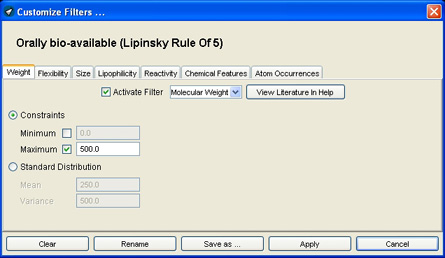
ilib:diverse supports various user-adaptable physicochemical property constraints for the generation of compound libraries. Most features are set by defining maximum/minimum values or a standard distribution (determined by mean value and variance).
ilib:diverse supports the following constraints for generated molecules
-
Weight — minimum/maximum and standard distribution
The molecular weight setting enables you to control the weight of generated molecules, which in part reflects their size.
-
Flexibility — minimum/maximum and standard distribution
Flexibility of molecules represents a major property of drug-like molecules and is characterized by the number of rings and the number of rotatable bonds (i.e. the number of exocyclic single bonds bound to non-terminal heavy atoms; amide C–N bonds are not considered because of their high rotational energy barrier). Rings mostly reduce flexibility, while the number of rotatable bonds raises flexibility crucially, resulting in a large conformational space. ilib:diverse supports all these features for determining the flexibility of drugs and additionally provides the relative number of rotatable bonds feature considering the ligand's size.
-
Size — minimum/maximum and standard distribution
Size enables you to control the size of generated molecules by setting the number of aromatic bonds (i.e. the number of bonds participating in aromatic systems), the number of bonds (i.e. the number of covalent bonds) and the number of heavy atoms (i.e. the number of all atoms except hydrogen). The size of molecules is determined by adjusting minimum/maximum values or by placing mean and variance for a standard distribution.
-
Lipophilicity — minimum/maximum and standard distribution
Lipophilicity crucially determines, among other things, the absorption of drugs. An appropriate setting for lipophilicity is vital for drug action and can be defined by log P (i.e. octanol/water partition coefficient) or the topological surface area (i.e. the sum of surface areas of polar atoms like oxygen, nitrogen and attached hydrogen in a molecule). ilib:diverse supports both features with an additional relative topological surface area option considering the size of the molecules.
-
Reactivity — on/off
Reactivity is a powerful feature of ilib:diverse that repels toxic and reactive groups from being built into compounds. The novel algorithms — based on common toxicological knowledge and the analysis of various databases containing drug-like molecules — recognize problematic chemical features and reject these compounds.
-
Chemical features — minimum/maximum
Chemical features like H-bond acceptors, H-bond donors, positive ionizable and negative ionizable are essential properties determining the ability of ligands to interact with proteins. While H-bond features increase the capability of building up potent interactions with proteins in order to stabilize the complexes, ionic interactions are vital for the approach of drug molecules to the targets.
-
Atom occurrences — minimum/maximum
The atom occurrences feature enables you to control the number of nitrogens, oxygens and halogens in generated molecules.
6.3.2. Adjusting filters
To create a new filter, click the filter checkbox in the process panel. Select from the filter drop-down menu the filter you want to modify or to utilize as an initial point for new filters, and click on the adjust button. A window will pop up allowing you to access all physicochemical property constraints of the current filter in card-index style.
Make your selections by activating the checkboxes and defining the constraints. Select Apply to return to the ilib:diverse main window, or save your entered settings by clicking on the Save as button. Remember that filter settings of existing filters can be overwritten. Clear erases all settings of the current filter after confirmation. To delete filters from the process panel use the delete filter option.
Warning
Too restrictive filter constraints may result in extensive calculation time and/or affect diversity.